- Home
- Paint Good Art
- Composition
- Lines and Shapes
How Do We Use Lines and Shapes in Compositions?
Lines are used to create emotion and movement throughout our paintings.
We use shapes to organize the composition of the artwork.
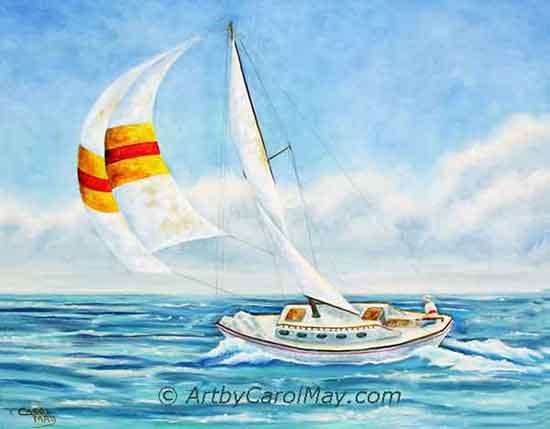 Lines and shapes create our compositions.
 Lines and shapes create a composition.
Lines Carry Emotions
Painting lines carry emotional energy or peace.
- Horizontal lines are calming and restful.
- Diagonal lines, even if they are implied, denote movement and dynamic energy.
In the sailboat painting above - the diagonal line of the mast and sails portray energy and movement. The horizontal lines of the water provide the painting with peace and stability.
Using Lines and Shapes for Good Composition
After we position the main subject, we are well on our way to an exciting painting.
There are good and bad lines and some shapes to avoid.
- Lines leading the viewer into the composition are desirable.
- There can be some lines that create problems.
- Geometric shapes may not be desirable.
Leading Lines Are Good!
Use implied or actual lines to bring the viewer into your paintings.
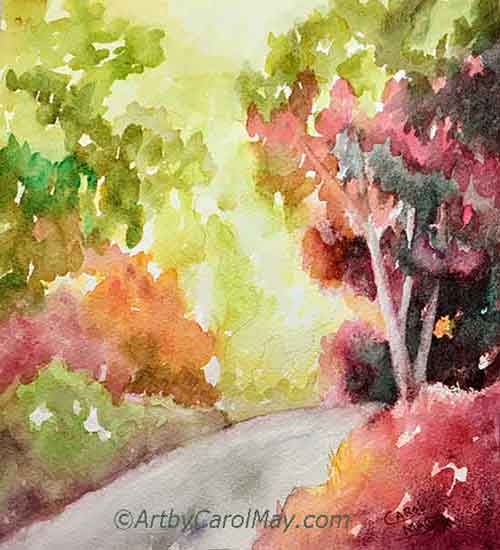 Enter the painting from the bottom left.
Artists often use actual lines leading into their artwork.
The line of a road, a river or a fence may be used to lead the viewers into the landscape painting.
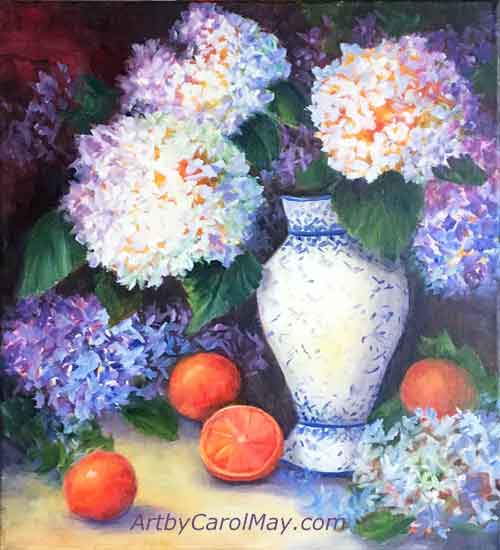 The oranges create an entrance.
Still life paintings may use a stem, the table cloth, etc. as a leading line.
In the painting above the oranges escort the viewer to the vase and then the eyes move around to the flowers.
Avoid Problem Lines
Avoid parallel lines close to the edge of the canvas. They will pull the viewer's eye away from the focal point and often out of the painting.
- For example, a tree trunk close to and parallel with the side of the canvas would not be desirable. It would tend to pull the viewer's eyes out of the painting.
- In the painting below, the lighthouse is well away from the side of the canvas. It tilts slightly toward the center of the painting to keep it from being parallel with the edge of the canvas.
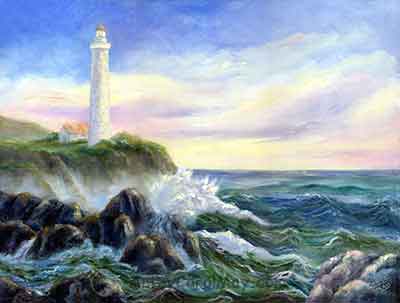 The eyes automatically follow lines.
Avoid lines going directly out the painting. They will lead the viewer's eye right out of the painting.
- This is especially true of lines going out the corners of the painting.
- The top of the lighthouse is subdued to keep the viewer's eye in the painting, instead of directing it out.
- The right side of the horizon line has the value contrast lessened and the edges softened to keep the viewers' eyes inside the painting.
Avoid long straight lines.
A long, straight line with no break gives the viewer a highway to travel right out of the painting.
A good composition will break a long horizon line.
Use a bird, a tree, a mountain or something to break the horizon line. We want to keep the viewers inside the painting.
- Remember, the horizon line of landscape paintings should be placed above or below the center line for good composition.
- Get more tips on how to paint good art.
How Do We Use Shapes in Our Paintings?
All the parts of a painting other than lines are a shape. We build our paintings with shapes.
Obviously, the shapes vary with the subjects we are painting.
But there are some shapes to watch out for.
Geometric Shapes
Geometric shapes are static and non-artistic.
Shy away from using definite geometric shapes like a square, circle or triangle.
Use your artistic license to change geometric shapes. We don't have to paint things exactly like they are in real life.
For example, we may have:
- A rectangular building: Move the view of the building to change its shape or camouflage part of the building with foliage or shadows, etc.
- A mountain shaped like a triangle: Put whoop-de-dos in the mountain to change its shape from a static triangle.
- A lake that is a circle: Meander the shoreline, so it's not a perfect circle.
That's the Joy of Being an Artist
We get to change the lines and shape to make them more artistically pleasing.
You Might Like These
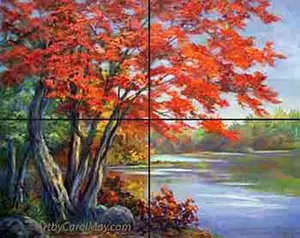
Rule of Thirds: Creates Easy Compositions
Artists use the rule of thirds to create dynamic compositions. It's our shortcut for easy composition that creates balanced paintings that attract the viewers.
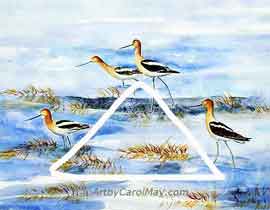
Are there different types of compositions in painting art?
There are 2 types of compositions in art paintings with many variations. See paintings of the common types; S-curve, pyramid, diagonal, circle, cross, radial, etc.
How to Paint Good Art: Fundamentals Create Awesome Art
Painting good art begins with the fundamentals; composition, focal point, color and values. See them in my painting with a checklist for assessing your art.
Principles of Art: Use Them with the Elements of Art
Create successful paintings using the elements and principles of art. Pleasing compositions are made using any combination of the 7 elements and 10 principles.
Composition in Art for The Painting Artist
A complete guide to composition in painting art: how to use lines, shapes, and placement to create balanced, harmonious paintings that attract the viewers.

Recent Articles


-
Design Paintings
Sep 04, 26 12:00 PM
 There are basic types of compositions in art paintings, symmetrical and asymmetrical. Most other compositions are variations of these two basic types. See paintings of the common types; S-curve, pyram…
 -
Good Compositon
Aug 27, 26 01:25 PM
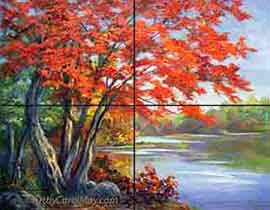 A good composition draws the viewers to our paintings. How do we make a good composition? When we are designing a painting a good rule is place the main subject (the focal point) left or right of the…
 -
Doing Oil Painting
Aug 09, 26 01:50 PM
 This how to do painting guide helps intermediate artists create a stunning artwork of a horse running in the surf. You will enjoy doing this step-by-step tutorial from the start to the finishing detai…