- Home
- Color Wheel
- Warm and Cool Colors
Warm and Cool Colors Impact Our Paintings!
Using warm and cool colors is a valuable skill for the painting artist.
Color temperature is our tool for creating dimensions, forms, and layering objects in our artwork.
Using a few of my paintings as examples, I will explain how and why I used the colors in each painting.
What Are the Warm and Cool Colors?
Let's look at the artist color wheel for the answers.
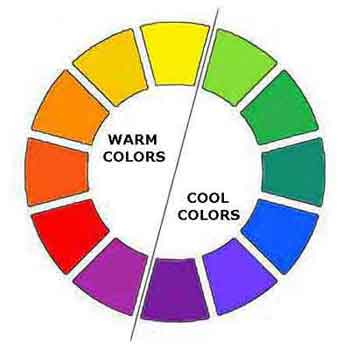
The colors are simply divided in half:
- Warm colors are yellow, orange, and red.
- Cool colors are blue and green.
The violets at the bottom of the wheel are separated because red-violet has warm red in it and the other one, blue-violet contains cool blue.
Green is a combination of warm yellow and cool blue. Even though, some greens can be quite warm, we still consider green as a cool color because it has blue in it.
Carol May is an award-winning artist who has painted nature subjects in watercolor and oil/alkyd for more than 40 years.
Through Art by Carol May, she shares 30-plus free step-by-step tutorials teaching beginners and growing artists.
Learn more on her artist page and find her on Pinterest. She shares the joys of painting and gives God the glory for every creative gift.
Warm and Cool Colors Create a Third Dimension
Color enables artists to paint the illusion of 3-dimensions on a 2-dimensional painting surface.
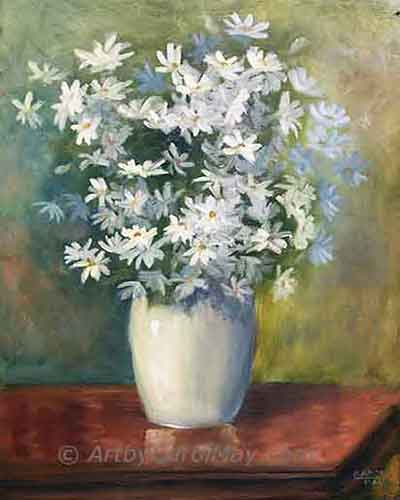 Create a three-dimensional painting.
Warm colors seem to come forward in the composition and make the objects appear closer than they actually are.
Cool colors on the hand, recede in the painting, thus creating a sense of depth and space.
In this painting, the cool blue and greens pushed the background back behind the warm colors of the flowers, vase, and table.
Titanium white straight out of the tube is a cool color, so I added some yellow and soft grays to warm the white.
The interplay between advancing warm hues and receding cool hues created the illusion of three-dimensions on our two-dimensional painting surface. How awesome is that!
How to Use Color to Create Forms
Using a cologne bottle I used as the vase in a rose painting, I'll show you how to form the bottle with warm and cool colors.
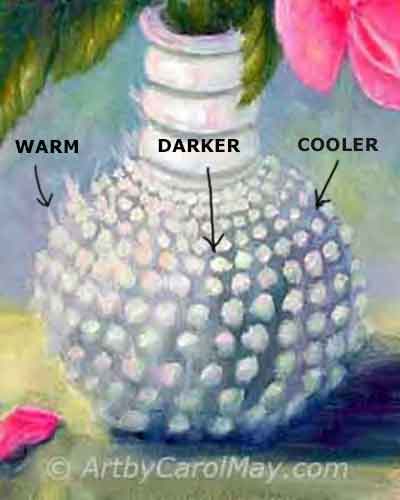 Shape the bottle using color temperatures.
You can see that I painted the nobs on the bottle a little smaller on each side. That is part of the illusion, but color temperature is important.
Everything on left is warm because the light is coming from the top, left.
The middle is closest to our view. The spaces between the nobs change to a cool dark blue.
The right curves away from view. The nobs are painted cooler and the blue between the nobs lightens in value, thus indicating the form of the bottle.
Many of the nobs are reflecting pink from the roses, except at the bottom where they are shadowed. There they are painted cool blue.
Use Color to Layer Objects
We can use color temperatures to put objects behind or in front of each other. Here is a watercolor painting of a young dolphin swimming beside mom.
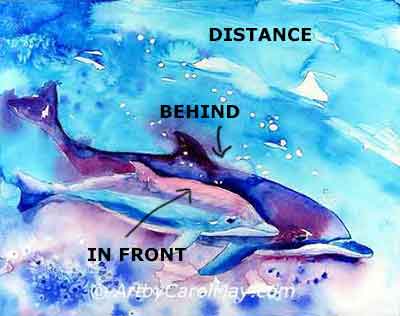 Place objects to the front or back.
The water: The water is a combination of cool blues that place it behind the warmer dolphins. It gets lighter up to the top right which moves it farther into the distance.
Mother dolphin: The mother is mostly a cold, dark blue. That pulls her in front of warm blue water.
Youngster: The top of the small dolphin is warm violet. That positions it in front of the mother.
Three In One Painting
Let's review space (the third dimension), form, and layering in one painting.
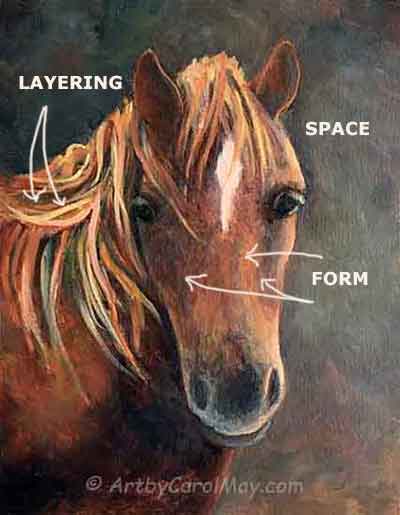 Color temperatures make a painting.
This pony painting clearly shows three ways we can use warm and cool colors.
The space of a third-dimension is created around the pony by painting it cooler than the warm pony. That pushes it into the distance, behind the pony.
The pony's head is warm down the center of its face. As the face turns back on each side, it gets cooler to create the form of the head.
The layers in the mane are cooler colors in between the strands. The strands are painted with warm colors to bring them forward.
The cool, dark colors were painted first. Then, it was fun painting the warm strands of the mane every which way.
How to Use Color Temperatures in Your Paintings
There are only two general things to remember:
Warm colors (containing yellow, orange, or red) advance forward and they make people feel good. For that reason, they often are a logical choice for the main subject, highlights, and things close to the viewer.
Cool colors (any color containing blue) recede and appear to move back into the distance. Cool colors are just as useful as warm ones, we use them to create three-dimensional space, create forms, and layer objects.
Colors are awesome! I enjoy sharing with you.
Keep From Mixing Muddy Colors
Warm and cool colors are the key to mixing clean colors. I explain it all on the Color Bias page. How to keep your color mixes from getting muddy.
You Might Find These Helpful
Choose Colors for a Painting: Select Harmonious Colors
How do we choose colors for a painting? You can create beautiful, harmonious paintings. How do professionals create beautiful paintings with only 3 or 4 colors?
Color Schemes in Art Create Vivacious, Harmonious Paintings
Discover how color schemes in art can transform your paintings by creating harmony, mood, and emotion. Explore popular schemes to enhance your artistic vision.
How to Mix Colors: Essential Tips for The Artist
Everything we need to know about how to mix colors for our paintings: colors for mixing, create color harmony, mix dark neutral colors, how to use in paintings.
Painting with a Limited Palette: Master Color Harmony
Discover the art of painting with a limited palette. Tune in to color harmony & craft a fun, colorful, harmonious step-by-step painting with only 4 oil colors.
Recent Articles


-
What Colors Mean?
Nov 27, 26 12:00 PM
 Empower your paintings with the right color choices. Learn the meaning of color and how color influences the viewers' emotions and perceptions. The indigo berries may make you think of eating. But usi…
-
Paint a Butterfly
Nov 13, 26 12:00 PM
 Have you wanted to paint a butterfly but you wonder where to start painting? This how to paint a butterfly tutorial teaches 5 easy steps for painting most any butterfly. Then choose a watercolor or oi…
-
Start a Painting
Oct 30, 26 12:00 PM
 How do you start a painting? Have you ever wondered what to paint first? Do you start painting the main subject, the foreground or the background? Learn the logic of what to paint first. Use the same…