- Home
- Painting Tutorials
- How to Paint Watercolor
- White Watercolor
Do You Know How to Paint White Watercolor?
We will look at several popular ways how to paint white watercolor in our paintings.
Many artists use the white of the watercolor paper, integrated into the painting.
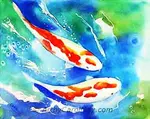
The fish painting below was painted with several watercolor techniques involving the use of the white paper.
 White makes our watercolors glow.
 White makes our watercolors glow.
The Techniques of How to Do White Watercolor
Do we use the white paper? How do we keep the paper white? Is there white watercolor paint?
Let's answer these questions with several examples.
A Common White Watercolor Technique
Notice the blue arrow pointing to the light-colored coral.
 The paper makes the white in watercolors.
This technique is often used to paint whites with watercolor.
No white paint was used on the coral.
It was painted with a color that was thinned with plenty of water.
This allows the white paper to show through the paint.
That's the beauty of painting watercolor. The colors literally glow from the white paper.
How to Do Watercolor White: Popular Techniques
These are the most popular methods of getting white in watercolor paintings.
#1 The easiest way to get white in watercolor.
 Paint around the white areas.
- Use the white paper by painting around the parts we want to remain white.
The fish body colors were painted around the white stripes.
After the body was dry, blue shadows were painted across the entire bottom of the fish, including the white stripes.
The body needed to be completely dry, so the blue and orange wouldn't mix and neutralize each other.
#2 A second popular way to get white in watercolor.
 Masking fluid made the water bubbles.
- Apply masking fluid where you want the paper to remain white.
Let masking dry and then paint around or over it.
After the paint is thoroughly dry, rub the masking fluid off to reveal the white paper.
Many people use a brush to apply masking fluid. For me, I find it hard to get small spaces with a brush.
A ball stylus embossing tool can be dipped into a bottle of masking. The round metal tips are easy to clean after applying the fluid.
Painting After the Masking Is Removed
 Masking fluid kept the coral colors clean.
Here, masking fluid was used on the edges of the coral before the violet background was painted.
The background color piled up against the edge of the masking.
To solve the problem, the extra violet could have been sopped up with a thirsty brush.
After the background was dry the masking was removed and the orange coral fingers were painted.
A Painting Using 2 White Paper Techniques
The beaches in Florida are wonderful. One time when I was walking the beach, I came upon an area with a whole bunch of little coquina clams.
See a Utube video of coquina clams.
That sparked my artist's instinct and the result was the painting below. It used the two popular techniques to preserve the white paper.
#1 paint around the white paper.
That's what I did with the foam on the beach. The sand colors were painted around the foam leaving it white.
After the sand colors were dry, some areas of the foam were softly tinted.
 Two popular ways to keep watercolor paper white.
#2 Keep the paper white with masking fluid.
The coquina shells were protected with masking while the sand was painted.
After the sand color was dry, it was removed with a pick-up eraser. We can also rub it off with dry fingers.
Be sure the paint around the masking fluid is dry before rubbing it off. Otherwise, we get a mess by moving the paint around. This tip is from unfortunate experience.
A Fun White Paper Technique
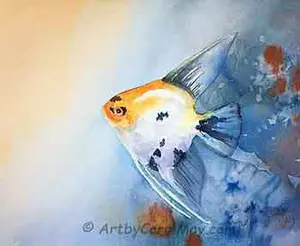
This is the large fish - in the painting at the top of the page.
 The paint may be scratched off.
It can be tedious painting individual scales. So:
I scratched out lines in a diagonal pattern to simulate the fish scales.
Be careful of using sharp tools on paper to prevent tearing the it. Less abrasive tools like an old credit card can be used to scrape without damaging the paper.
Masking preserved spots of white for the highlights on the scales.
After removing the dry masking, the highlights were painted according to their surrounding colors, pale violet, light green, etc.
10 Ways: How to Do Watercolor Whites
Here are ten common methods of protecting or recovering the white paper.
- Leaving the white paper unpainted is the easiest way to get white into our watercolor paintings.
- Masking fluid
(also called frisket) is a liquid rubbery type
substance that is applied to areas before painting. It is removed when
the watercolor paint has dried, thus exposing the white paper.
- Frisket sheets can be cut to shape. Use them to cover large areas. Cut them a tiny bit smaller than the area you are protecting. Then use the liquid frisket to seal down the edges.
- Artist masking tape may be used. It is good for straight lines like the horizon or a building.
- Lifting preparation may be applied before painting. Then the paint may be removed down to the white of the paper.
- Sand paper may be used to remove the paint from the tops of the bumps of watercolor paper for added texture.
- Scratching and scrapping tools are available to use on Aquabord, Claybord and other art panels. That's what I used for the fish scales.
- A brisk water stream from a spray bottle will wash some paint away. Then blot up the loose paint and water.
- A damp brush can be used to lift paint. A stiff brush works the best. Rub the brush to loosen paint and then blot up the loose paint with a paper towel.
- A wax crayon may be used on an area you don't want to paint. The area's color in the final painting will be the color of the crayon.
Do We Use White Watercolor Paint?
There is an opaque Titanium White watercolor paint. It can be mixed with colors to lighten them, but it makes the colors opaque and chalky looking.
Unpainted watercolor paper provides the brightest, cleanest whites.
Either titanium white watercolor or white gouache, may be painted on top of a dry color. Thinning them makes them less opaque and creates a dull white.
The white paper is always brighter and cleaner looking, than painting white over another color.
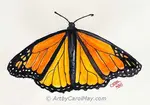
You can see an example of doing it both ways in this butterfly tutorial.
Successful watercolor paintings require planning and techniques to preserve the whites.
White adds sparkle and vitality to our artwork.
You Might Like These
Glazing with Watercolor for Beautiful Effects
Glazing with watercolor is the key to rich, luminous paintings. Learn how to layer transparent colors effectively with our comprehensive guide and expert tips.
Watercolor for Beginners: Paint Your Dreams
Watercolor for beginners: transform your dreams into reality with our comprehensive resource to empower you as you enter the captivating world of watercolor.
Watercolor Art Supplies on Art by Carol May
These watercolor art supplies are tried and true. What works for me will work for you; best paint, what to paint on, brushes, palette, can you paint on canvas?
How to Paint Watercolor: A Complete Beginner's Tutorial
Learn how to paint watercolor with our fun, step-by-step tutorial. We'll guide you through basic techniques as you create a beautiful angelfish painting. Easy!
Recent Articles


-
Start a Painting
Oct 30, 26 12:00 PM
 How do you start a painting? Have you ever wondered what to paint first? Do you start painting the main subject, the foreground or the background? Learn the logic of what to paint first. Use the same…
-
Home Art Studio
Oct 16, 26 12:00 PM
 What's the advantage of having a home art studio? When your creative juices are flowing your own painting space would be ready and waiting. Where would be a good place to put your art studio and what…
-
Paint a Fun Dog
Oct 02, 26 12:00 PM
 It's easy to paint this fun dog on canvas. This is a great way for beginners to start using oil paint. Follow the easy steps that use only three colors to paint this puppy dog. You can learn and use p…