- Home
- Paint a Beach
The Secrets of How to Paint a Beach
This page takes away the mystery and guides you on the essential techniques of how to paint a beach.
Who doesn't love the ocean? Imagine the sounds of the crashing waves, the salty sea breeze and the warmth of the sun.
With a dash of inspiration and the step-by-step instructions, you can do a beach painting.
 Seascapes are exciting to paint!
 Seascapes are exciting to paint!
Steps to Painting the Ocean:
- Step 1 – Practice Simple Shorelines (This Page)
- Step 2 – Focus on Waves and Water Movement How to Paint a Wave
- Step 3 – Understand Ocean Colors and Light How to Paint Ocean Colors
- Step 4 - Paint an Entire Ocean Scene How to Paint Ocean
- Step 5 – Add Details to Your Seascapes (New Lessons Coming Soon)
What Do We Use for the Beach Painting
The painting may be done with oil paint, alkyds or acrylics. This is an alkyd painting. Alkyds are my favorite 'oil paint' because they dry much faster than oils, but not as fast as acrylics.
11x14 stretched canvas: I recommend smaller canvases for practice and learning. They take less time and materials to complete. Canvas boards are also good for practice.
Flat brushes work great for seascapes. The brush size depends on your canvas size, judge appropriately. This painting used #2, 4 and 6 flat brushes.
Clean-up for both oils and alkyds use Gamsol odorless mineral spirits.
Paint colors:
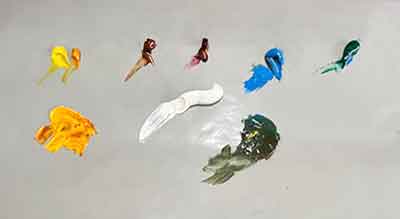 A gray palette lets us see the values.
- Cadmium Yellow or Indian Yellow
- Alizarin Crimson
- Burnt Sienna
- Cerulean Blue
- Viridian Green
Lay out your colors on the palette from warm to cool with a large amount of white.
Mix a dark neutral color - use Cerulean, Burnt Sienna and a little Viridian.
We will use this dark neutral throughout the painting to tone down the other colors, so they aren't too garish.
On the left I was checking on mixing an orange with yellow and Alizarin Crimson. (You don't need to mix it yet.)
If you struggle with picking the right blues and greens for your seascapes, visit How to Paint Ocean Colors first. It walks you through ocean color palettes and then applies them in a step-by-step painting.
How to Paint a Beach Perfectly
This painting is done in five steps.
- Paint the sky
- Block-in the ocean and beach colors
- Paint the darks
- Highlights
- Finish with the details
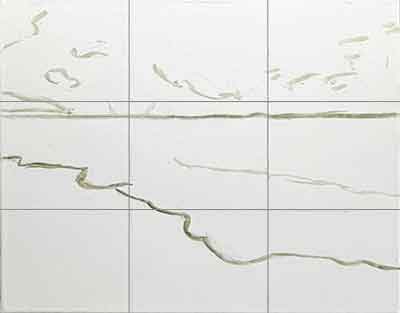 Place the focal point on the third's lines.
Before we start painting, outline a sketch on the canvas. Thinned yellow paint is best, because it's easy to paint over. (I used darker paint for the photo.)
Pencils may be used. Sketch with a hard pencil because dark graphite from a soft pencil is difficult to cover.
Divide the canvas into thirds with light pencil lines. Use the lines as a guide to help you with the sketch.
Notice, the horizon line is about one third down from the top. That places the sun on the intersection of the third lines. Using the rule of thirds makes the composition easy.
Start Painting the Sky
We will paint a sun-lit sky with the sun just above the horizon.
Each of the sky colors are mixed with white. Use a minimal amount of solvent or medium - just enough to make the paint go on.
Start in the upper right corner with a mixture of Cerulean, a little Viridian, and a touch of Burnt Sienna.
1. As you paint across the sky keep adding more white toward the left and toward the horizon. Paint yellow in the area around the sun. Leave the sun unpainted.
2. Mix oranges with Alizarin, yellow and/or Burnt Sienna. Paint orange going away from the sun. Add neutral mix to the orange and paint the point of land. Blend the top into the sky.
3. Using unthinned paint, touch on some orange clouds near to the sun and your neutral mixture for the clouds farther away from the sun.
4. Gently blend the clouds into the sky with a dry brush. Wipe the brush on a paper towel between colors.
Note: If the brush is cleaned with solvent between colors, the damp brush will pull paint off the canvas instead of blending the colors.


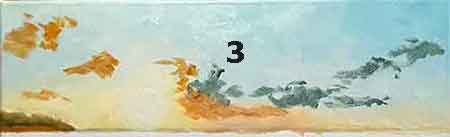

In the future, I will be doing a page with more details on how to paint clouds.
Block-in the Colors
We want to cover the canvas with the approximate colors. That enables us to see the values without looking at a white canvas.
Use paint thinned with a little bit with your solvent or medium.
Block-in the Water
Mix Cerulean Blue with Viridian and speck of your neutral mix to tone down the color. Then add white to get your desired value.
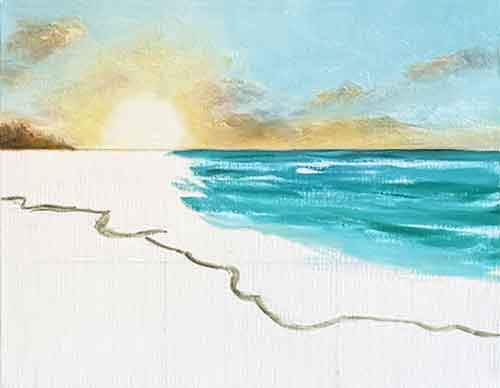 Casually paint in the ocean water colors.
The water is the darkest at the horizon.
- Paint from the horizon down.
- Stroke from side to side leaving the white canvas showing in places.
- Gradually angle the strokes down on the right, as you near the beach.
Don't worry about spots or streaks, in fact leave them for some color variations.
Block-in the Beach
The sky colors are reflecting on the wet beach sand.
Paint mixtures of yellow, Burnt Sienna, and white. Use yellow close to the light, then Burnt Sienna moving away from the light.
Add touches of
Cerulean or neutral mix to dull the colors farther away from the
light.
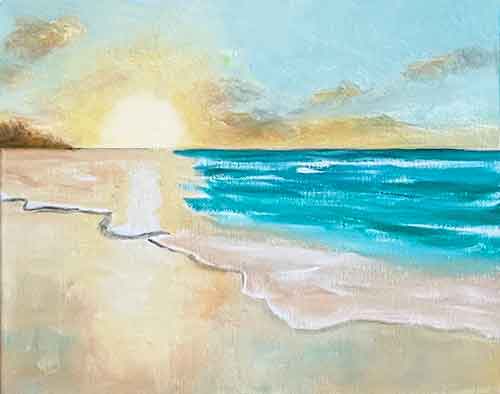 Paint the beach colors lighter in the sun's path.
Gently merge and blend the colors together. A little bit darker color at the bottom edge of the canvas will keep the viewer's eyes in the painting.
Leave the water side of the foam outline on the beach unpainted. (It gets foam painted on it later.)
Paint the Dark Colors
Mix Cerulean and Viridian (no white) for the darks in the ocean water.
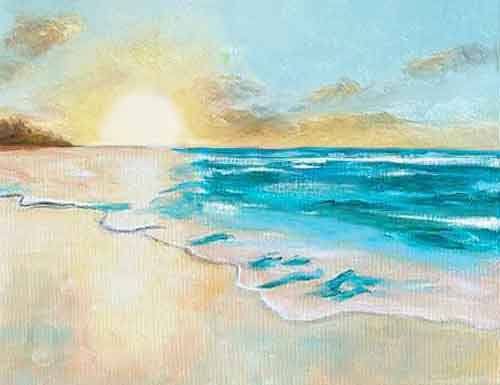 Paint the dark colors under the top of the waves.
Paint the dark color under what will be the top of the waves. Paint it intermittently, not the full width of a wave.
You can clearly see the added darks by looking at the image with squinted eyes.
Put a few darks on the beach in the direction of the water movement. These will become the darker areas under the beach foam.
Highlights
Highlight the top of the waves in a few places where they are capping.
Mix a warm white by adding a touch of either yellow or Burnt Sienna.
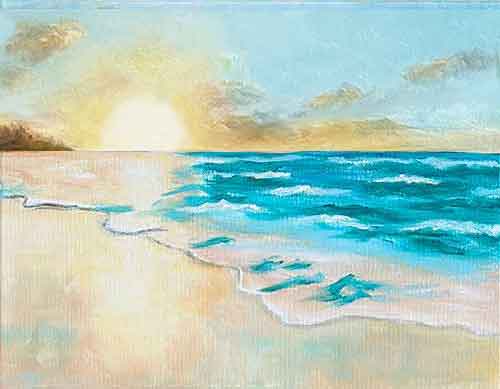 Paint white caps on some of the waves.
Load the brush with the warm white.
- Hold the brush handle parallel to the canvas with the side edge of the bristles toward the canvas.
- Gently pull the brush across the canvas to release paint without it mixing into the wave color.
- Just lightly touch the brush to the canvas where you want white foam (don't stroke the it on). The paint itself makes more interesting shapes, instead of us trying to paint the shapes.
See the next image: Using a clean dry brush, gently blend the 'bottom edge' of the white caps into the water color. Do not blend their tops.
Soften or blend the edges of the dark colors where desired.
How to Paint the Beach Water
Mix a cool white with Cerulean, white, and a speck of Burnt Sienna or neutral mix.
Paint the cool white on the edge of the water and the foam rolling up on the beach.
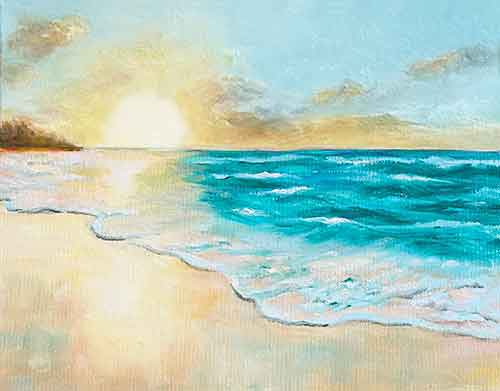 Paint a cool white on the beach water and foam.
How to paint the beach foam:
- Paint the cool white portions of all the beach foam. Paint in the direction of the water movement.
- Use a gentle touch to pull the color over the reflected sky colors. Leave areas of the beach sand showing through. Do not blend.
- Shadow the foam (using thinned neutral mix) intermittently paint a shadow under the edge of the foam.
- Soften the bottom edge of the shadow with a dry brush to make it flow gently into the sand color.
Finishing Details
There are a few final things to paint.
- Paint the white sun and its reflection on the beach. Use straight paint with nothing added. Softly blend the edges of the white into the surrounding colors.
- Put more color into the water on the left to bring the composition into balance.
- You may put a few warm white touches on the beach foam.
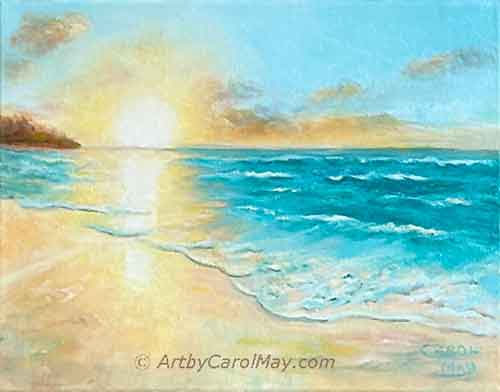 Paint the sun, its reflection and water on the left.
Each piece of artwork is an individual. Step back and look at the painting from a distance. See if there are any other things to refine.
Sometimes, it helps to set the painting aside for a day or two; then look with a fresh eye. We may see something to adjust that we didn't notice before.
Now - You Know How to Paint a Beach!
Paint with confidence and enjoy the process. Painting art is about expressing yourself, and what better way than painting a beach scene.
There are more ocean how-to pages for your pleasure on ArtbyCarolMay.com.
You Might Like These
How to Do Oil Painting: Tutorial of A Horse & Ocean
How to do oil painting: This step-by-step guide helps intermediate artists create stunning artwork of a horse, from start to finishing details, artist Carol May
Paint a Waterfall with Beauty and Drama
Paint a waterfall to add beauty, drama and mystery to our landscape paintings. Add a waterfall to any of your oil paintings, only 3 steps with full instructions
How to Paint a Wave: Step-by-Step Oil Painting Tutorial
How to paint a wave with oils. Join artist Carol May for a step-by-step tutorial. How waves are made, their shape, colors, draw and paint a wave with 5 steps.
How to Paint Ocean Colors: Palette, Mixing & Tutorial
How to paint ocean colors beautifully? Get inspired with creative tips and guidance in a tutorial to master the art of capturing the ocean's stunning hues!
Recent Articles


-
The Big Three
Sep 18, 26 12:00 PM
 You can create good art using the big three painting fundamentals. Learn how to paint good art with good composition including a focal point, values and color choices. Use these three important fundam…
 -
Design Paintings
Sep 04, 26 12:00 PM
 There are basic types of compositions in art paintings, symmetrical and asymmetrical. Most other compositions are variations of these two basic types. See paintings of the common types; S-curve, pyram…
 -
Good Compositon
Aug 27, 26 01:25 PM
 A good composition draws the viewers to our paintings. How do we make a good composition? When we are designing a painting a good rule is place the main subject (the focal point) left or right of the…