- Home
- Paint a Butterfly
- Watercolor Butterfly
Watercolor Butterfly: Realistic Step-by-Step Tutorial
Do you want to know how to paint a watercolor butterfly that looks real?
Watercolor gives us the option of expressing ourself with either loose imagery or more detailed realism. This butterfly tutorial contains a combination of both.
Combine your passion for learning to paint with the beauty of butterflies.
Looking for more butterfly painting lessons? Visit the Paint a Butterfly hub page to explore all the butterfly tutorials.
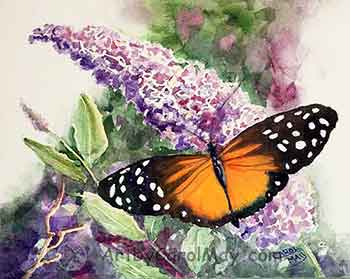 You can paint a butterfly!
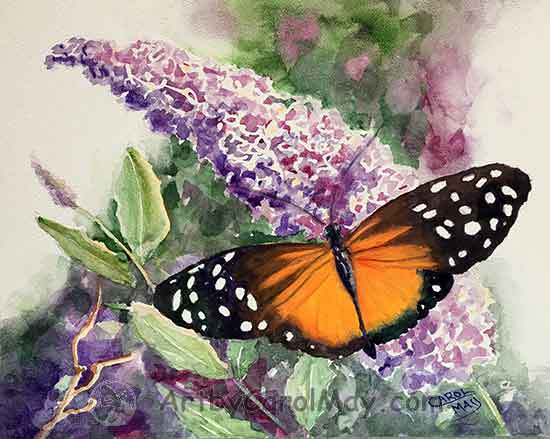 You can paint a butterfly!
Paint a Realistic Watercolor Butterfly
Watercolor is a lovely painting medium. My first art lessons were with oils, but it was hard for me to paint fine details.
Then I found watercolor and started painting butterflies. Enjoy painting this lovely butterfly with me step-by-step.
Materials and Sketch
We are going to be painting on my favorite watercolor support Aquabord, an 8"x10".
|
BRUSHES:
|
COLORS:
|
The three colors, orange, green and violet are equally spaced around the color wheel. That's what is known as a triad color scheme. The triad scheme always creates a balance of colors.
You may want to use a different color scheme.
Sketch the Butterfly
It's good to have a reference for realistic paintings.
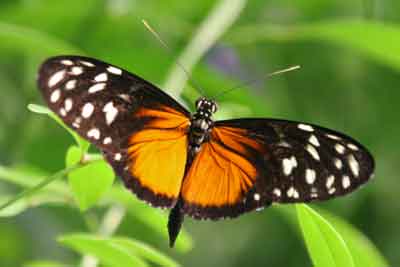 It's good to have a reference.
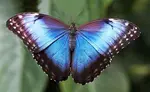
Here's a photo of a stunning butterfly. For the flower and leaves I went outside and looked at my Butterfly Bush. (Sorry I didn't take a photo.) Refer to the finished painting.
For the composition I placed the butterfly to the right of center, facing into the painting.
Lightly sketch the
long-wing butterfly with the Butterfly Bush flower, stem and leaves on
your painting surface.
How to Paint White with Watercolor
Watercolor paintings most often use the paper as the white color.
In this painting we will use two common methods of preserving the white paper.
1. Apply Masking Fluid
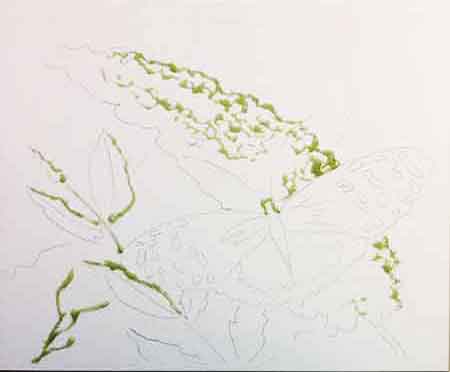
Apply masking fluid to areas on the flower and leaves.
Let it dry before painting. It takes about 30 minutes to dry.
You may speed the drying with a hair dryer. Don't get it too hot or it will be hard to remove later.
2. Paint Around the White
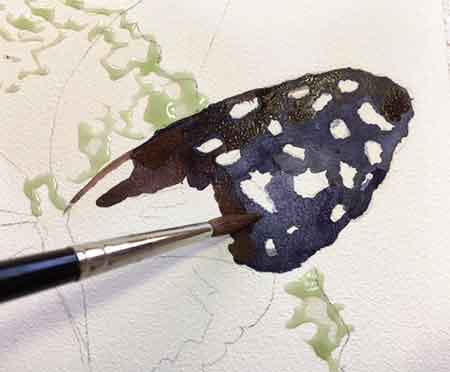
Leave some areas of the paper white by painting around those areas.
This creates the brightest whites.
There are other techniques for preserving the white watercolor paper.
How to Paint Your Watercolor Butterfly
Mix a dark color with Viridian and Dioxazine Violet.
Start Painting the Wings
Paint around the white spots on the butterfly's wings.
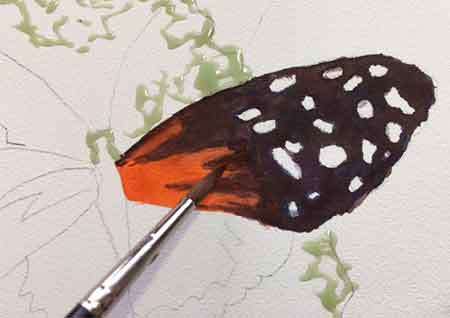 Add brown, then orange closer to the body.
Add orange to warm the mixture and make it brown for the areas closer to the body.
Use less water to make the darker colors.
And obviously more water makes lighter colors. That's an important key of how to paint with watercolor.
When you near the butterfly's body start adding orange.
Blend the orange into the brown.
How Many Wings Do Butterflies Have?
While painting a real butterfly, let's note a bit of butterfly anatomy - butterflies actually have four wings and six legs.
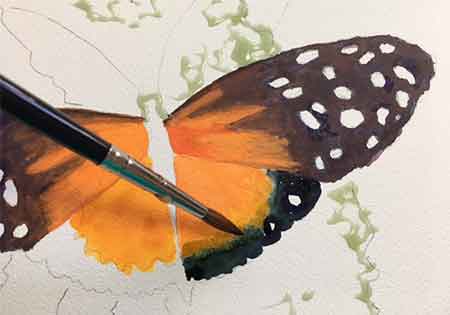 Continue painting the butterfly wings.
The wings and legs are attached to the thorax, the fat part of the body behind the head.
You can faintly see the division between the fore-wing and the hind-wing going at an angle up to the thorax (middle part of the body).
Paint the dark border on the hind-wing.
Feather the colors together by running a clean damp brush along the juncture of the dark and orange.
The water is the important part of painting watercolor butterflies. Using more water produces lighter colors.
If necessary, darken the areas around the white spots with a second layer. Adjust the shape of the white spots where needed.
Paint the Butterfly's Body
Now turn your attention to the butterfly's body.
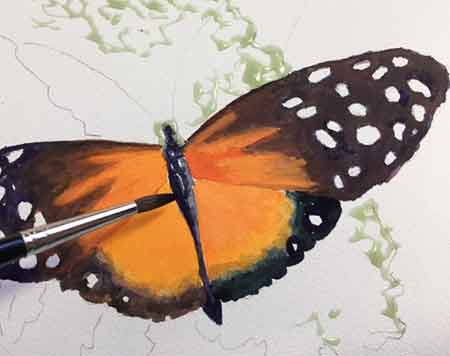 Paint the body with some highlights.
Assuming the light is coming from the right side.
Use the dark mixture from the wings and paint the shadow side of the body.
Add a little more water to the mixture and paint the right side of the body lighter.
Leave a few highlights for added interest.
The body is partially covered by the edges of the hind-wings. The tail end of the body peaks out behind the wings.
Complete the Wings
Add a few dark veins to the fore-wings with brown.
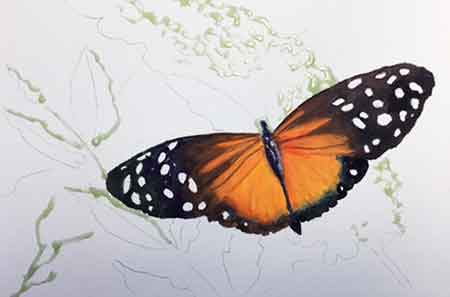 Paint the veins on the wings.
Lightly suggest veins in the hind wings.
We will paint the butterfly head and antenna after the flower is painted.
Look over your butterfly. Is there enough contrast between the white spots and their surrounding black?
Does the orange color transition smoothly into the brown?
When you are satisfied with your watercolor butterfly, move on to the flower and foliage.
Paint the Flower and Leaves
Paint the flower with dark and light purples.
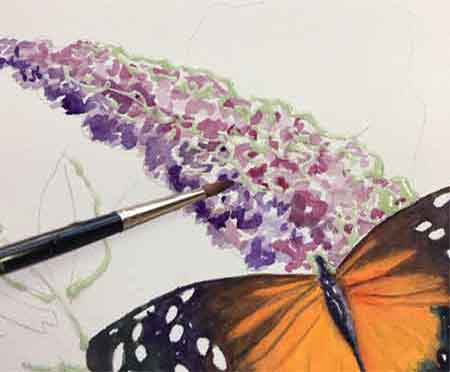 Start painting the flower.
Loosely paint the flower with a stippling motion.
Use your red-purple, Quinacridone Violet on the light side of the flower.
Use the darker, cooler blue-violet, Dioxazine Violet on the shadow side.
Get more tips on how to use warm and cool colors.
Notice the masking fluid preserves the white highlights on the flower.
Also, paint around some areas leaving the white of the paper.
The Leaves
Mix and use a variety of grey-greens for the leaves using Viridian and Dioxazine Purple.
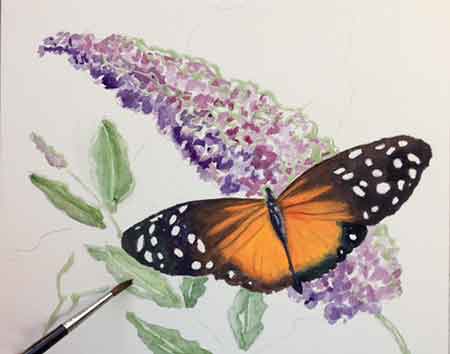 Paint the leaves.
Paint the leaves with a variety of light and darker greens.
Leave a center vein unpainted on some of the leaves.
For added variety paint the center vein darker on other leaves.
We'll paint the stem after the masking fluid is removed.
We don't paint any green on the flower blossom. That's the masking fluid that looks a little green in the photo.
Watercolor Techniques for the Background
Dampen the area you will be painting, so the paint will flow on easier.
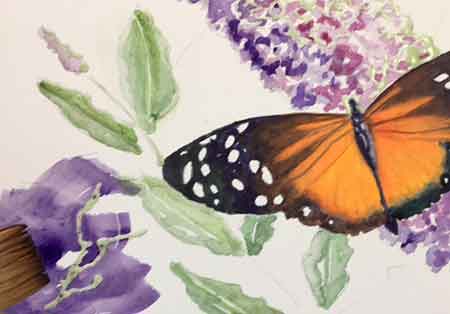 Start painting the background.
Loosely paint the background with a soft flat brush.
Start the lower left corner with Dioxazine Violet.
As you start adding the greens to the background it will grey the violet, so it is not so intense.
Loose backgrounds are one of the joys of painting watercolor. An artistic background contrasts nicely with the detailed butterfly.
We want the background to compliment, not detract our attention from the detailed focal butterfly. What are other ways to create a focal point?
Change to warmer violet (Quinacridone Viole)t and a variety of greens farther up in the painting.
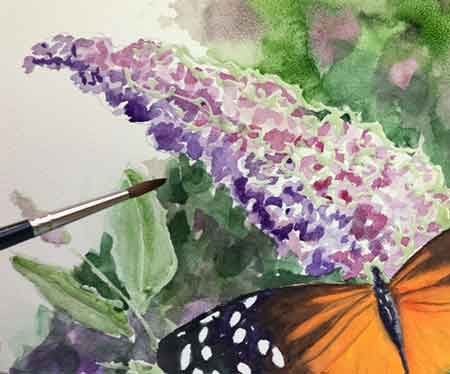 Continue painting the background.
Use a smaller brush for the tighter areas.
Paint lighter, subdued greens or lavender farther out in the background areas.
While the paint is still wet - use the smaller brush paint some darker greens or violet into the lighter areas.
Mingling the background colors together to make them out of focus.
The out of focus background pushes it to the back and brings the butterfly, flower and leaves forward.
Above the flower - a spray of water mixes the background colors to make them more out of focus.
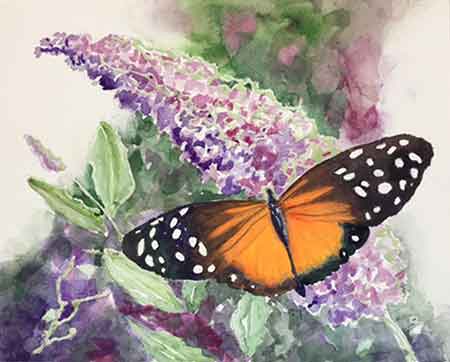 Make the background out of focus.
Use water on the edges of the background to soften the colors and merge them into the white background.
In the tighter areas below the flower, use a damp brush to mingle the colors and soften the edges.
The wet colors flow together.
That's the beauty of painting watercolor.
Let the entire painting dry.
Detail the Flower, Foliage and Butterfly
The painting is dry when it is does not feel cool to the touch.
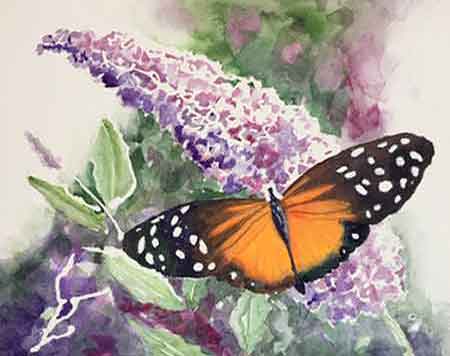 Remove the masking to reveal the whites.
Now comes another fun part of watercolor.
It is always exciting to see the whites revealed.
After the painting is dry remove the masking fluid (the frisket) with a rubber cement pick-up tool or your dry fingers.
When the frisket is removed the white paper is revealed!
Voila - there's our highlights.
Soften any edges and add darks where desired.
One of the techniques of painting good art is to repeat colors throughout the painting.
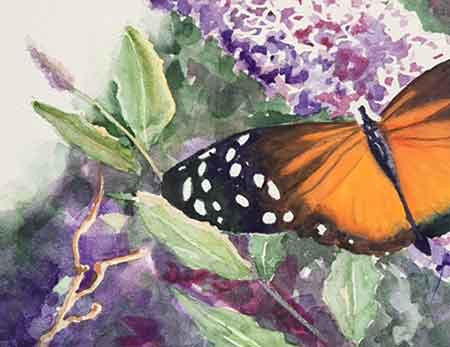 Add touches of a pale orange.
The butterfly is obviously orange.
So, we use some orange on the leaves and twig.
Use a pale orange wash on the edges of the leaves.
The twig in the lower left was painted with brown with orange highlights.
Remember the light source is from the right. So, we highlight the right side of the twig with shadows on the left.
Finish the Butterfly
Complete painting with the butterfly head and antenna.
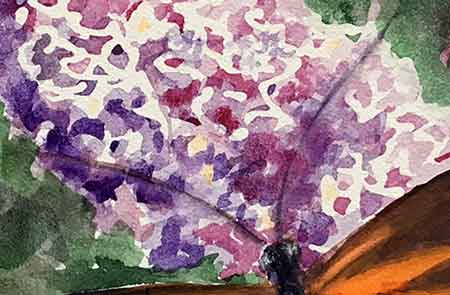 Paint the butterfly head and antenna.
The flowers on the purple Butterfly Bush have orange centers.
Lightly indicated some orange in a few places on the flowers.
Now we can finish the butterfly's head.
Paint the butterfly's head and leave highlights for the eyes.
A script liner brush works for painting the slender antenna.
The Painting Is Finished
This is how to paint watercolor butterfly art. The realistic butterfly is meticulously painted over an artistic background that makes the painting more interesting.
White sparks up the painting and the addition of bold colors make this a lively butterfly painting.
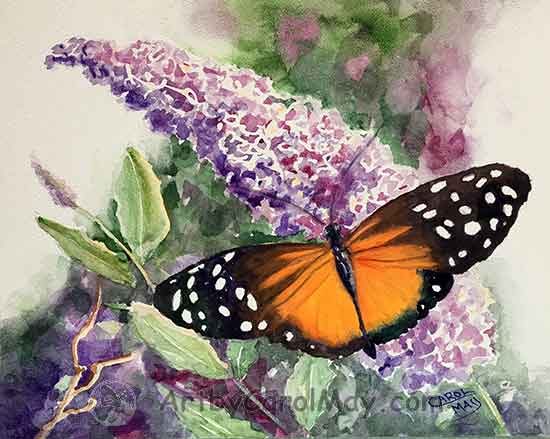 Completed painting
It's Your Turn to Paint
The combination of nature and creativity offers a wonderful opportunity for artists.
Both seasoned and budding artists can express their creativity, perfect their watercolor techniques and add imaginative artwork to their portfolio.
Explore and look deeper into the world of painting art on this website. The vast reservoir of resources is waiting to help you create your next painting.
Butterflies Art Timeless
Oil paintings are as timeless as the butterflies.
Enjoy this classic medium while you paint this butterfly.
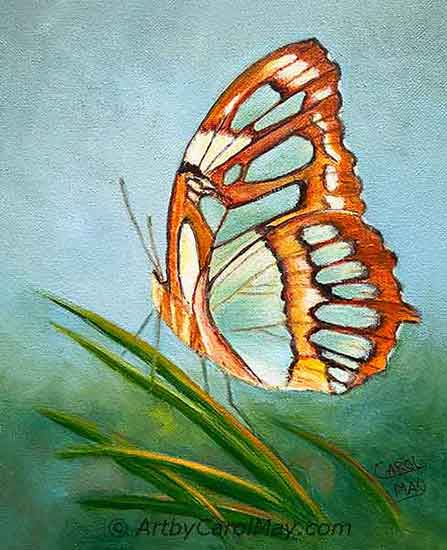
Paint More Watercolor
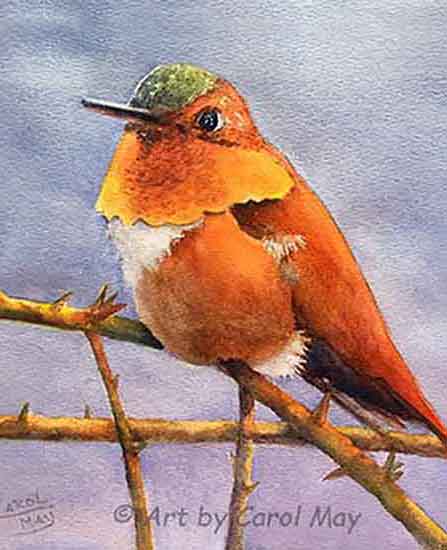
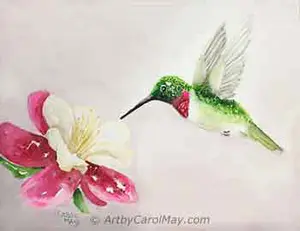
Watercolor is a wonderful medium for painting hummingbirds, too.
Paint this Rufous Hummingbird with only three colors.
For more butterfly painting lessons - including easier projects and different styles - visit Paint a Butterfly.
More Pages to Enjoy
Watercolor for Beginners: Paint Your Dreams
Watercolor for beginners: transform your dreams into reality with our comprehensive resource to empower you as you enter the captivating world of watercolor.
White Watercolor: How Do We Paint White in Watercolor?
How do we paint white watercolor? Popular techniques of how to do white in our watercolors. How do we keep the paper white? Is there white watercolor paint?
Painting Daylilies: A Watercolor Flower Tutorial
Start painting daylilies with a step-by-step watercolor tutorial by artist Carol May. Watercolor is easy to use, the perfect medium for painting pink flowers.
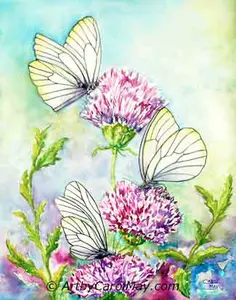
Painting Butterflies with Watercolor Flowers Tutorial
Enjoy painting butterflies in watercolor with a step-by-step tutorial combining butterflies and flowers in a natural composition by painting artist Carol May.
Recent Articles


-
Design Paintings
Sep 04, 26 12:00 PM
 There are basic types of compositions in art paintings, symmetrical and asymmetrical. Most other compositions are variations of these two basic types. See paintings of the common types; S-curve, pyram…
 -
Good Compositon
Aug 27, 26 01:25 PM
 A good composition draws the viewers to our paintings. How do we make a good composition? When we are designing a painting a good rule is place the main subject (the focal point) left or right of the…
 -
Doing Oil Painting
Aug 09, 26 01:50 PM
 This how to do painting guide helps intermediate artists create a stunning artwork of a horse running in the surf. You will enjoy doing this step-by-step tutorial from the start to the finishing detai…