- Home
- Hummingbird Paintings
Hummingbird Paintings of Flying Jewels
It's such a pleasure doing hummingbird
paintings. These
amazing little birds
are full of color and personality.
Nature and all its beauty are awesome! When the light hits the hummingbird's iridescent feathers, they shine like jewels in the sunlight.
It is a challenge for the artist
to paint their iridescent feathers and catch their energetic flight. But I
like a challenge.
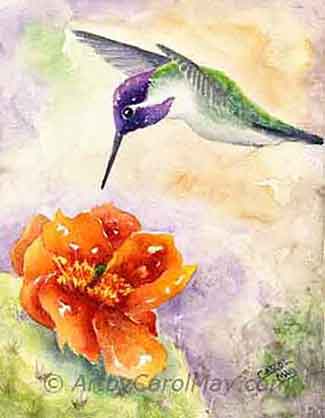 Costa's Hummingbird
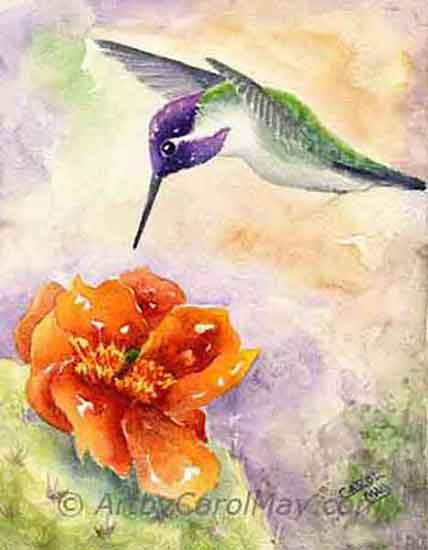 Costa's Hummingbird
The "Costa's Hummingbird" has a blue-violet flared gorget and head. They are found in desert areas and build their nests in cacti and yuccas.
He is feeding from a Prickly Pear cactus flower. You don't see many hummingbird pictures with cactus.
The flowers aren’t really that orange in real life, but I used my artist’s license, as I did in doing all of these hummingbird paintings.
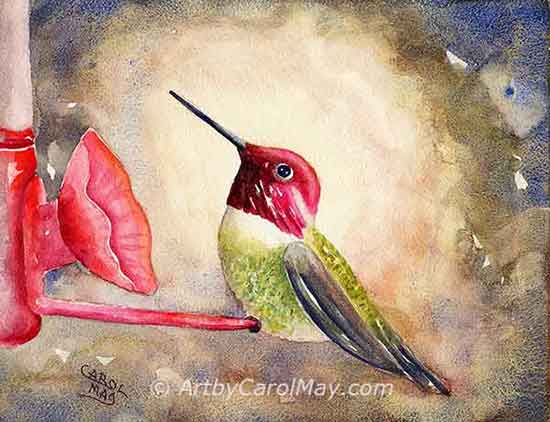 Anna's Hummingbird
The "Anna's Hummingbird" has a flared rose-colored gorget, the same color on his head.
My husband took a photo of a Ruby-throated Hummingbird on our feeder's perch. I used his photo for reference and changed the Ruby-throat Hummingbird to an Anna's Hummingbird.
The red on the feeder with the hummer's red head made a beautiful hummingbird painting.
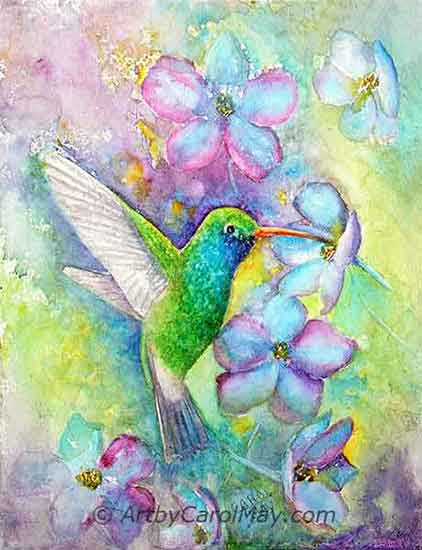 Broad-billed Hummingbird
The "Broad-billed Hummingbird" has a natural freedom with its iridescent greens and blues.
They also have an orange bill. Most other hummers have dark bills.
The painting was done on watercolor canvas. It is more difficult to get detail on the canvas. The colors slide around on the canvas, so I did the delphinium flowers in a free style.
What other materials do I use for painting watercolors?
The freedom in this hummingbird and flower painting made it a joy painting hummingbird art.
Enjoy the Hummingbird Paintings
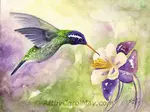
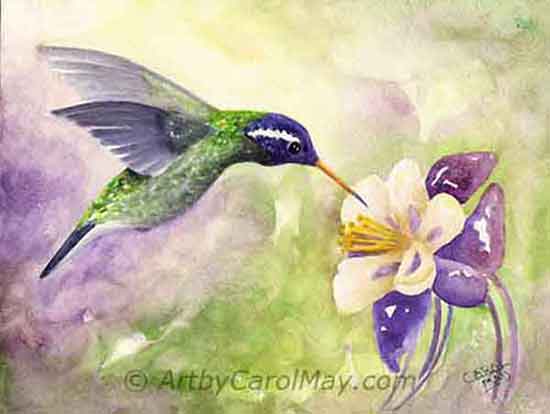 White-eared Hummingbird
The "White-eared Hummingbird" is about the same size as the Ruby-throat Hummingbird. It is seen in the high pine forests in Arizona, New Mexico and more rarely in west Texas.
The male has purple on his head with the identifying white mark behind the eye. In this watercolor painting I show him here feeding from a Columbine flower.
It's a joy painting our God's gift of flying jewels.
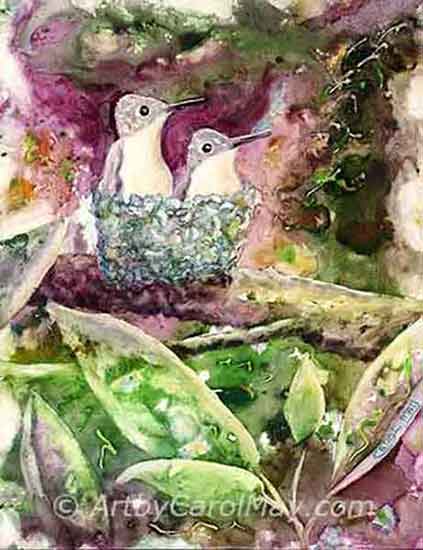 Tiny Treasures
A couple of precious baby hummingbirds, "Tiny Treasures" are in their nest waiting for mom.
Hummingbird nests are usually less than two inches in diameter. They put soft materials inside of the nest and often camouflage the outside of the nest with pieces of bark, moss or pieces of lichens.
The foreground leaves give the idea of how small the baby birds and their nests actually are.
My sister found a hummingbird nest in her yard. I finally got to see one in real life. And it was covered with lichens.
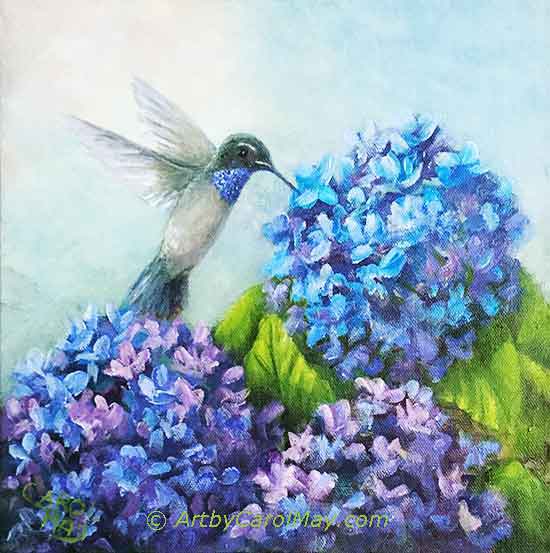 Blue-throated Hummingbird
The Blue-throated Hummingbird made a perfect complement to the blue Hydrangea flowers.
It is one of the largest hummingbirds seen in the United States. It is about five inches, compared to most hummers that are around three to four inches.
See photos of other types of hummingbirds you may want to paint.
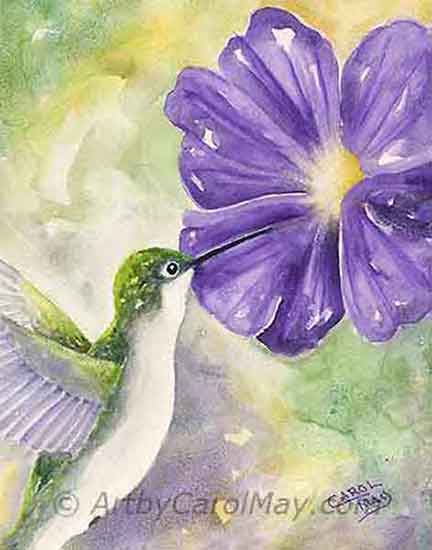 Hummers-Eye-View
I was wondering what kind of hummingbird painting to do next and I had a vision of a female hummingbird flying up to a petunia flower.
Sometimes God gifts us with ideas to paint. Thank you, Lord. So here came the painting, "Hummer's Eye-view".
Plant some hummingbird flowers to invite the hummers to your yard.
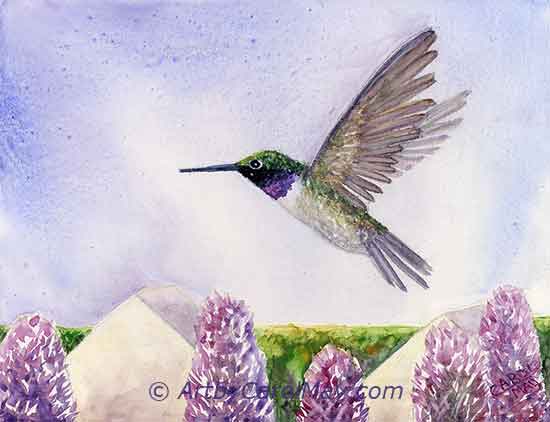 Black-chin with Liatris
The Black-chinned Hummingbird is the western version of the Ruby-throat. The Ruby-throat lives from the Midwest to the Atlantic coast.
The Black-chinned lives from Montana and Texas to California. These two types of hummers look very similar. Except the Black-chin, does in fact have a black chin and its throat shines purple.
"Black-chin with Liatris" was painted with purple flowers to complement its throat. The sky has a purple hue to tie the painting together.
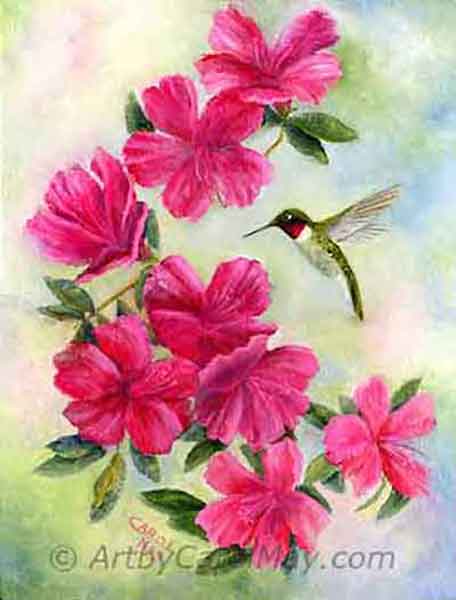 Spring Beauty
I enjoy painting hummingbirds. Lately I have been doing watercolor paintings, but this is one of my favorite hummingbird paintings done in oils.
It is a Ruby-throat Hummingbird with spring blooming azaleas.
Actually, where I live the azaleas, finish blooming a couple of weeks before the hummingbirds fly in. But I thought it would make a beautiful hummingbird painting.
So, I used my Art by Carol May artist's license for this painting of "Spring Beauty".
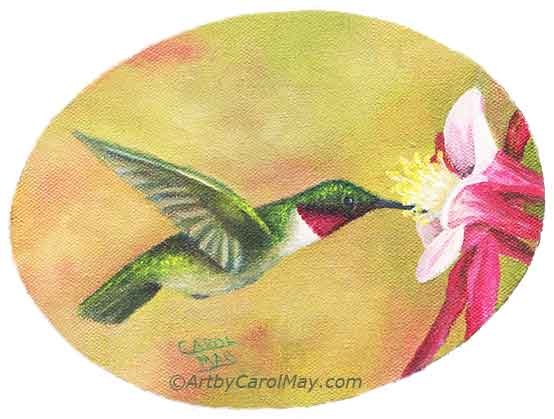 Ruby-throat Feeding
Hummingbirds are fascinating. They have been the subject of many of my bird paintings over the years.
This little oil painting of a "Ruby-throat Feeding" was done when round and oval canvases were popular with the artists.
The Ruby-throated Hummingbird is the most popular type of hummingbirds in the United States. We see them all across the lower states. Then they fly south for the winter. Occasionally a few may spend the winter in south Florida.
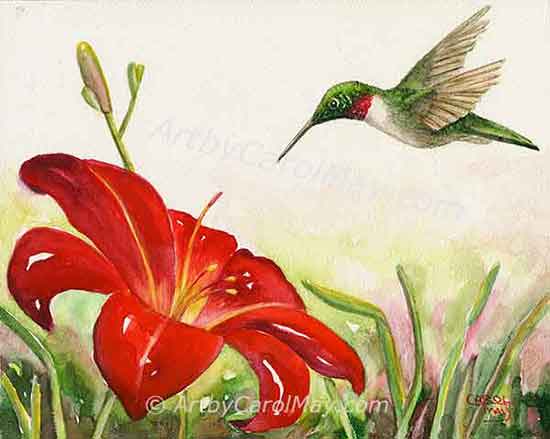 Ruby-throat Hummingbird visiting a Daylily
I love planting flowers for the butterflies and hummingbirds. Plus, the hummingbirds come to their feeders, especially if they have red on them.
One day when I came home and approached the porch, there was a "Ruby-throat Hummingbird visiting a (red) Daylily". What a treat!
I had no idea that hummingbirds ate from daylilies. But I have since seen them feeding from more daylilies of other colors, too.
Do You Want Some Hummingbird Art in Your Home?
Many of the original paintings of hummingbirds have been sold. However, you may get a beautiful archival reproduction for your home.
They may be printed in a variety of sizes from note-cards to wall decorations. They can be printed on paper, canvas, wood or even metal.
You may view the paintings in large sizes. One is sure to suit your decor!
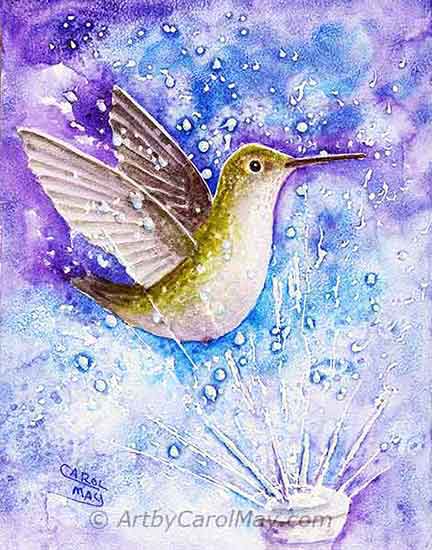 Lady's Bath
This was a fun hummingbird painting.
We had a sprinkler in a large two-level birdbath. Lots of other birds made good use of the birdbath. We even saw deer and a fox come for a drink.
But, we never saw the hummingbird bathing in the water. Instead we would see them flying through the spray from the sprinkler.
The water droplets in the painting were made from spots of masking fluid. There are more ways to preserve the white of watercolor paper.
It's a Joy Painting Hummingbirds and All the Birds!
You might like these
Paint a Hummingbird with Radiant Colors in Oils
Confidently learn how to paint a hummingbird with oil paints. Paint the beautiful iridescent colors of a male Broad-billed Hummingbird, a step-by-step tutorial.
Types of Hummingbirds in the United States
Identify 15 types of hummingbirds that visit the United States with photos, information and identification tips, Ruby throated Hummingbird, Black chinned, Annas
How to Watercolor: Paint a Beautiful Hummingbird
How to watercolor like a pro! This captivating tutorial guides you through every step, from choosing materials to painting a breathtaking hummingbird scene.
Art Prints for Sale by The Artist Carol May
Fine art prints for sale by the artist Carol May. Enjoy the beauty of landscapes, seascapes, flowers, butterflies, hummingbirds, and many interesting critters.
Recent Articles


-
Home Art Studio
Oct 16, 26 12:00 PM
 What's the advantage of having a home art studio? When your creative juices are flowing your own painting space would be ready and waiting. Where would be a good place to put your art studio and what…
 -
Paint a Fun Dog
Oct 02, 26 12:00 PM
 It's easy to paint this fun dog on canvas. This is a great way for beginners to start using oil paint. Follow the easy steps that use only three colors to paint this puppy dog. You can learn and use p…
 -
The Big Three
Sep 18, 26 12:00 PM
 You can create good art using the big three painting fundamentals. Learn how to paint good art with good composition including a focal point, values and color choices. Use these three important fundam…